
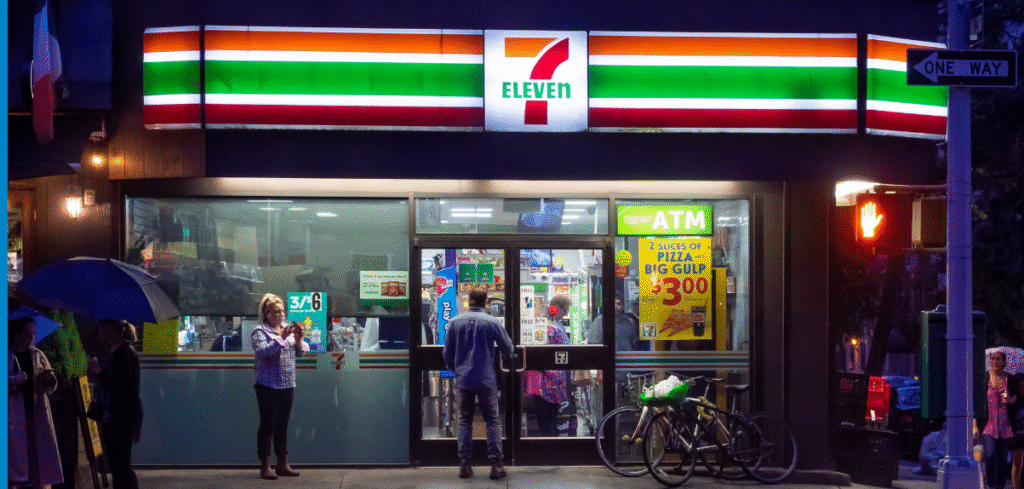
When stepping into a 7-Eleven in Japan, it quickly becomes clear that it’s much more than a place to buy something quickly. People handle their daily groceries, pay bills, and even send parcels with ease. These stores are part of everyday life and are as natural as public transport. Customers can also use copy machines and printers, which are widely used by students and schoolchildren.
For those without a home computer, this is a practical solution. Prepaid cards for phones and online games can also be purchased, which appeals especially to younger customers.
Many locations are equipped with payment machines that accept both cash and cards for all services. This wide range of uses makes the stores attractive for people of all ages.
Popular with tourists
For visitors, it’s often one of the first discoveries during their trip. On TikTok and Instagram, thousands of videos show travelers proudly sharing their purchases.
Even singer Sabrina Carpenter shared her favorite snacks from a Japanese convenience store in 2023, and that video received over 600,000 likes. This international attention highlights how appealing the stores are.
Many tourists praise the cleanliness of the stores and the consistent quality of the products. Because these shops are found on almost every corner, they are a familiar sight in large cities and smaller towns.
Visitors also find it helpful that most important machines provide English-language instructions. This makes the stores accessible even to those who don’t speak Japanese.
Large network
The biggest name is 7-Eleven, with nearly 22,000 branches across all 47 prefectures. Other chains such as FamilyMart and Lawson also compete strongly, together adding tens of thousands of additional stores.
In total, there are more than 55,000 of these shops throughout Japan. This makes it nearly impossible not to find one nearby.
This network provides a sense of security for residents who know they can always rely on the same services. It also increases accessibility to daily essentials in rural areas.
Thanks to this wide presence, convenience stores contribute to the vibrancy of neighborhoods. They have become recognizable gathering points for locals and travelers alike.
American beginnings
The origin was not in Japan but in Dallas, where Southland Corp. opened the first store in 1927. It wasn’t until 1974 that the first Japanese store appeared in Tokyo’s Toyosu district.
Back then, shelves mainly held American products like hamburgers. Within two years, one hundred shops had opened, proving the model’s success in Japan.
The Japanese market was very receptive to the idea of small stores with many functions. For many residents, it provided a new way of shopping that saved valuable time.
The concept fit perfectly with Japan’s growing urban lifestyle, where efficiency and speed are highly valued. This allowed the chain to establish itself quickly as a strong player.
Always open
In 1975, a branch in Fukushima tested whether 24-hour service would work. The idea became so popular that it was adopted almost everywhere.
The stores turned out to be perfect for people wanting to shop after a long workday. Students and young professionals also appreciated the flexible hours.
Being open around the clock quickly became one of the brand’s defining features. It showed that the chain was tuned into Japan’s fast-paced city lifestyle.
By the 1990s, 7-Eleven had already become an essential part of daily life. Many residents had grown accustomed to the idea that everything was always close by and available.
Japan takes ownership
In the 1990s, the brand came largely under the control of Ito-Yokado and 7-Eleven Japan. Since 2005, the chain has been fully owned by Seven & i Holdings, a Japanese company now active worldwide.
This gave the business more control and flexibility to adjust the assortment to local tastes. New services, such as advanced payment methods, were also introduced.
Japanese leadership drove strong innovations that set the brand apart internationally. By keeping up with trends in food and technology, the stores remained appealing to new generations.
The Japanese approach emphasized quality and efficiency, giving customers a sense of reliability. This turned 7-Eleven into a model for similar chains around the world.
Worldwide success
With more than 83,000 stores in 19 countries, 7-Eleven is the largest retail chain globally. In the United States and Canada alone, there are more than 13,000.
In the coming years, the company plans to invest billions in further growth, focusing especially on North America. This shows the brand still has plenty of potential outside Japan.
The success proves that the concept works universally. Yet, the Japanese execution is often cited as the gold standard for the entire chain.
Other countries study Japan to learn how a convenience store can play a social role. The Japanese model continues to inspire global retail practices.
Local lifeline
In rural areas, traditional services like small supermarkets and banks often disappear. Convenience stores step in to fill this gap.
They offer ATMs, sell tickets for buses and concerts, and even provide printing services. For older residents in smaller towns, this often becomes a vital daily stop.
Young families also benefit from the stores’ proximity, as it makes daily life much easier. Some branches even host local events or promotions.
In this way, smaller towns stay connected to a larger network of services. It ensures residents don’t need to travel far to get things done.
Safe space
According to researcher Gavin Whitelaw of Harvard, these stores also function as a kind of public space. He observed children doing their first solo errands there, and women who found comfort inside.
During special events, the stores provide food, water, and information to the community. Staff members are helpful and are trained to support people with questions.
The bright lighting makes the stores feel welcoming, even during quiet hours. For many residents, this creates a reassuring sense of accessibility.
Because they are nearly everywhere, convenience stores are seen as friendly anchor points within the community. It demonstrates how commerce and social function can complement each other.
Inside the store
These shops are clean, brightly lit, and neatly organized. You’ll find onigiri, sandwiches, hot meals like croquettes, and steamed buns.
There are coffee machines, and in summer, refreshing smoothies are available. The range changes often, giving customers the sense that there’s always something new to try.
Many stores provide tables and microwaves, allowing people to eat meals right there. For those on the go, this is a practical option.
The balance between Japanese flavors and international favorites ensures everyone finds something they enjoy. This combination of local and global appeal is part of the charm.
Seasonal flavors
Another unique aspect is that the assortment changes with the seasons. In spring, there are sweets flavored with sakura cherry blossoms.
In Okinawa, you’ll find Okinawa Soba on the shelves, a regional noodle soup with meat. In summer, chilled drinks become popular and match the warm weather perfectly.
During the winter, hot dishes such as stews and soups are introduced. This seasonal rotation gives the stores a dynamic character that fits well with the Japanese calendar.
Around holidays, you’ll often see special desserts or gift sets. Visiting a convenience store feels different throughout the year, adding to the excitement.
Key-points
- 7-Eleven began in the U.S. but became iconic in Japan.
- The chain has more stores worldwide than any other retailer.
- In Japan, convenience stores are a mix of supermarket, bank, and community space.
- They play an important role during special events and in small towns.
- The assortment changes by season and region, making each visit unique.